What is sebaceous hyperplasia?
Have you noticed tiny, soft, skin or yellow-coloured bumps on your forehead, nose or cheeks that never seem to pop or go away? You may be seeing sebaceous hyperplasia. These are benign overgrowths of oil glands, which are normal parts of our skin’s anatomy. And although they are reassuringly benign and painless, they can draw the eye, and become a cosmetic nuisance.
Although they can look like acne, there are tell-tale differences. Acne bumps are usually inflamed and tender, whereas sebaceous hyperplasia tends to be complelely asymptomatic, and persists for months or years. It is more common from midlife onwards, and long-term sun exposure seems to make lesions more likely to appear on the face over time. Although a lot of people might not be aware of the name of these lesions, they are actually incredibly common with an incidence of up to 1% in the healthy population.
Why getting examined matters
Here is a common worry: could it be skin cancer? Some benign bumps mimic early skin cancers, including basal cell carcinoma. If a lesion bleeds easily, grows quickly, ulcerates, or develops irregular colour, it deserves prompt review. A dermoscopic assessment in clinic helps us see subsurface patterns that distinguish harmless glands from concerning changes, reducing unnecessary procedures and missed diagnoses.
If there is uncertainty, we may remove or biopsy a lesion so a pathologist can confirm it is benign before cosmetic treatment continues. This is especially important in older adults, who have a higher background risk of skin cancers. The goal is your peace of mind and an accurate plan that prioritises safety first.
Causes and risk factors
Sebaceous hyperplasia reflects how your oil glands age and respond to environment. Ageing skin and cumulative sun exposure are common drivers, which is why we see these bumps most often on chronically sun-exposed areas of the face.
Genetics and naturally oilier skin do play a part, explaining why some people develop many lesions while others do not develop this concern at all! Certain medicines and hormonal shifts can also contribute. For example, long-term immunosuppressive treatments such as cyclosporine have been linked with multiple lesions.
Treatment overview: how choices are made
As with most skin lesion treatment options can vary according to the appearance, size and number of the lesions as well as each individual’s downtime preferences. Most plans combine at-home skincare with in-clinic procedures. For many, a topical retinoid can help to limit new bumps forming, while targeted removal methods address the existing lesions for quicker cosmetic improvement.
Each option carries trade-offs. Topicals tend to provide gradual skin improvement and prevention, whereas cautery or laser-like treatments flatten bumps fast but may involve small crusts and a short healing period. Your clinician will talk you through longevity, scarring or pigment risks, plus how likely new lesions are to appear over time. This shared decision-making ensures your plan fits your goals and lifestyle.
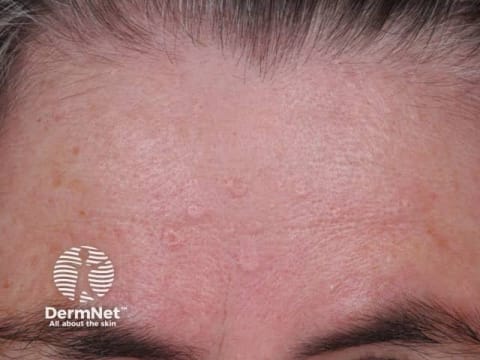

(Images Courtesy of https://dermnetnz.org/topics/sebaceous-hyperplasia)
In-clinic treatments: effectiveness, risks, and who benefits
Good news first: most lesions respond beautifully to precise, clinic-based care. The right choice depends on accuracy, skin tone, number of bumps, and your preference for speed versus downtime.
Electrocautery or electrodesiccation
This is the treatment option that we offer in our clinic at present. A fine electric tip gently heats and collapses the gland, flattening the bump there and then. When performed carefully with low current, healing is usually smooth with minimal marks, though temporary skin changes such as pink discoluration and a mild dipping at the area of treatment is expected in the first few weeks and this then improves and resolved over time. This is a quick, widely available option that treats individual lesions efficiently.
Cryotherapy
Liquid nitrogen freezes the gland. It can work, but because oil glands sit slightly deeper, some lesions need repeat freezes or multiple sessions. There is also a higher chance of pigment change compared with cautery. For that reason, we often reserve freezing as a second-line option when other methods are not suitable especially as it’s effectiveness is less predictable.
Surgical shave or excision
Best for a stubborn one-off bump or when diagnosis is uncertain. A small shave or excision can remove the lesion and, if needed, provide tissue for pathology confirmation. This suits isolated cases and those where diagnostic clarity is essential. it is also the recommended treatment option in really thick or raised bumps.
LASERs
Ablative lasers like CO2 can precisely flatten lesions in a similar manner to electrocautery, whereas non-ablative lasers can shrink lesions over several sessions with minimal downtime, often chosen for diffuse, widespread lesions.
Your daily routine to support results
If you have ever wondered whether skincare can fix these bumps entirely, here is the honest answer: skincare cannot remove established lesions, but the good news is that targeted, evidence based skin care can reduce oiliness, improve texture, and slow new bumps from appearing, especially when paired with in-clinic treatments. Think of it as maintenance for clearer, calmer skin.
In addition to oil-control, a routine that focuses on promoting or preserving collagen helps to preserve the architecture of our skin meaning that skin bumps can appear less prominent.
AM routine
- Cleanse: If your skin feels dry on waking, a water rinse can suffice. However if your skin feels oily first thing in the morning, then start with a gentle cleanser.
- Treat: Apply a niacinamide serum to help regulate sebum and support the skin barrier. Start 3 to 4 times per week and build up. Consider combining with a Vitamin C serum for ultimate antioxidant support and for collagen synthesis support.
- Protect: Use a lightweight broad-spectrum SPF 30 to 50 daily. Many patients find a fluid SPF can replace a morning moisturiser, preventing heaviness while protecting collagen.
PM routine
- Cleanse: Single or double cleanse depending on makeup or SPF usage through the day. A clean skin allows for better penetration of active ingredients and helps regulate oil levels.
- Retinoid: Apply a retinoid 2 to 3 nights per week, increasing as tolerated to regular use.These encourage a healthy cell turnover meaning they bring new, healthy cells to the skin’s surface and they stimulate collagen, meaning the skin is plumper, more resilient and with reduced fine lines. They also help with regulating oil production so they are truly a great hero product.
- For bonus gentle oil-control support, your Niacinamide serum can be use at night time as well, either in combination with your retinoid (apply most watery serum first), or on nights when you aren’t using your retinoid.
- Moisturise: Finish with a light gel-cream to buffer actives and support comfort.
Optional 2 to 3 times per week
- Gentle chemical exfoliation, such as a mild glycolic or lactic acid, can brighten skin and help to regulate oil levels.
Aftercare, recurrence, and prevention
Here is what most people ask next: how long will it take, and will it come back? Retinoids and supportive skincare take weeks to months to show visible changes, and stopping them can allow lesions to gradually return. Consistency is your friend. Daily broad-spectrum SPF 30 or higher becomes non-negotiable, especially when using retinoids or after procedures, to protect collagen and reduce sensitivity.
Keep moisturisers lightweight and non-comedogenic to maintain the barrier without clogging the skin with heavier products. Avoid picking or trying to pop these bumps. They are not spots, and squeezing risks inflammation, scarring, or colour change. If a lesion catches or irritates easily, let us assess it. A tiny, precise treatment in clinic is far safer than DIY attempts.
It is important to know that even after in-clinic treatments sebaceous hyperplasia lesions can persist or recur as they represent an overgrowth of a normal part of the skin’s anatomy.
What to expect at our clinic
Curious about the journey? Your consultation includes a careful history, dermoscopic exam, and shared decision-making. If there is any diagnostic doubt, we will discuss biopsy or excision so we treat safely and confidently. But do rest assured that the majority of these lesions are safely and effectively treated with electrocautery. We then tailor a plan that blends at-home skincare with targeted in-clinic options, matching lesion count, your skin tone, and downtime preferences. You will leave with clear aftercare guidance, realistic timelines, and follow-up plans that always include complimentary top-up treatments where a treated lesion has been particularly stubborn. Our London dermatology clinic focuses on safe, natural-looking results that respect your skin and your routine.
Summary
Key takeaways
- Sebaceous hyperplasia is a benign overgrowth of oil glands that often appears on the forehead, cheeks or nose from midlife onward.
- Professional assessment matters, as some bumps resemble skin cancers, and dermoscopy improves diagnostic accuracy.
- The most effective approach blends at-home prevention with skin care, combined with precise in-clinic removal treatments.
- Skin tone, sensitivity, and rosacea guide treatment choices to minimise pigment change and maximise comfort[VS] .
What to do next
Ready to start exploring safe, supported skin lesion treatments? Book in for a bespoke skin consultation to create your tailored plan, or visit our treatments page to learn more and plan your next steps. We are here to help you choose safe, evidence-based options for healthy, glowing skin.